By this age, you thought it might be easier. Your child is 7… maybe 8 or 9. They can talk. They can reason. They should be able to handle things better by now… right? And yet—
They melt down when it’s time to turn off the TV.
They shut down when something doesn’t go their way.
They get stuck on one shirt, one pair of pants and the whole morning unravels if it’s not right.
And you’re left wondering: “Why are they reacting like this? They’re not a toddler anymore.”
If that’s been your experience, you’re not alone. And more importantly; this doesn’t mean something is wrong with your child.
Big Emotions Don’t Expire at Age 5
In our last posts, we talked about two important shifts:
Behavior is communication
Your child isn’t a problem to fix—they’re a person to be understood
That still holds true here even as kids get older. Because while your child’s language has developed— Their nervous system is still learning how to handle stress, frustration, and change.
So those big reactions? They’re not immaturity. They’re signals.
What’s Happening Underneath the Meltdown
TV Transition
Let’s take a common moment: TV to Dinner Transition.
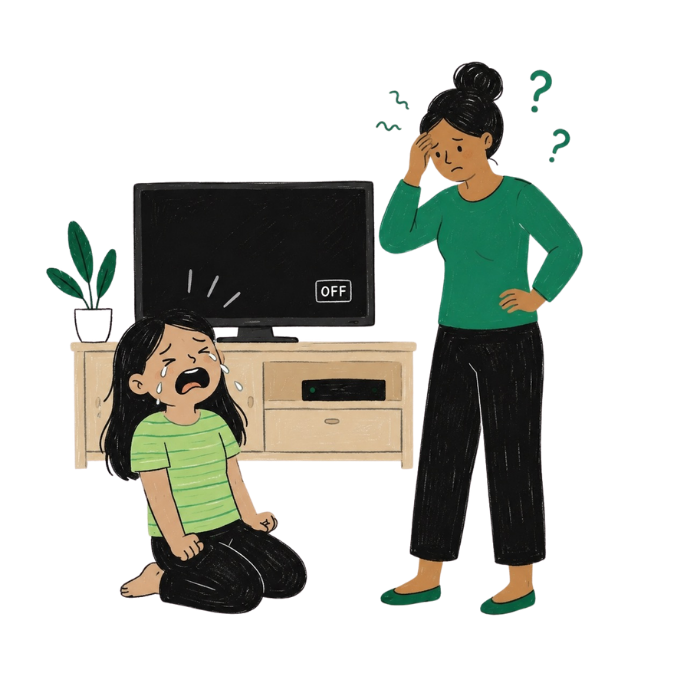
You say, “Hey, turn off the TV. It’s time for dinner.”
Your child:
Ignores you
Groans loudly
Snaps, “Wait!”
Or suddenly melts down when the TV goes off
It looks like defiance. But underneath? Their brain is going through a hard stop.
They were:
Focused
Regulated
In a predictable, enjoyable activity
And now:
The transition feels abrupt
Their brain has to shift gears quickly
Their body may register that shift as stress
What looks like overreacting is often a nervous system struggling to transition.
Morning Rigidity
Or this one: They have to wear a specific shirt. It’s dirty. Or doesn’t fit the weather. Or just isn’t available. You offer alternatives.
They:
Refuse
Get upset quickly
Shut down or escalate
From the outside, it can feel confusing—or even frustrating. But underneath?
That shirt might represent:
Predictability in a busy morning
A sense of control before school
Comfort in an environment that feels overwhelming
What looks like rigidity is often a need for safety.
Meltdown vs. Shutdown
Not all big emotions look loud. Some kids:
Yell, cry, stomp
Others:
Go quiet
Withdraw
Say “I don’t care”
Refuse to engage
Both are forms of dysregulation. Both are your child’s way of saying: “This feels like too much right now.”
Why “Just Calm Down” Doesn’t Work
When your child is in a meltdown or shutdown, their brain isn’t in a place to reason. They’re not thinking: “What’s the logical next step?”
They’re feeling:
Overwhelmed
Flooded
Stuck
Their nervous system needs safety before it can access skills. This is why consequences, lectures, or even well-meaning logic often fall flat in the moment. Not because your child is ignoring you, but because they can’t access what you’re asking for yet.
Bringing Back “Pause + Wonder”
This is where the tool from our last post becomes even more powerful.
Pause
Slow the moment down (even if everything in you wants to speed it up).
Wonder
Ask:
“Is this a hard transition?”
“Are they overwhelmed right now?”
“What might help them feel safe or steady?”
And don’t forget: “What do I need right now?” Because your nervous system matters too.
What This Can Look Like
TV Transition
Instead of: “Turn it off now. I’ve already asked you three times.”
Try:
“Hey, I know it’s hard to stop when you’re in the middle of something.”
“Let’s pause it together. Do you want to turn it off, or should I help?”
“After dinner, we can come back to this.”
You’re not removing the limit. You’re adding connection to the limit.
Morning Rigidity
Instead of: “You’re not wearing that. Just pick something else.”
Try:
“You really wanted that shirt today, huh?”
“Mornings can feel rushed. Let’s figure this out together.”
Offer 2 choices instead of 10
You’re supporting their need for control and predictability, while still holding the boundary.
For the Parents Wondering If They’re Missing Something
Sometimes these moments can feel bigger than just behavior. You might find yourself wondering:
“Why is this so hard for them?”
“Am I handling this the right way?”
“God, help me know what they need…”
If that’s you, you’re not alone. And you’re not expected to have all the answers. Sometimes the most faithful thing you can do is stay present, stay curious, and reach for support when things feel beyond what you can hold on your own.
When Big Emotions Keep Showing Up
If your child:
Has frequent meltdowns or shutdowns
Struggles with transitions regularly
Gets stuck in rigid patterns
Feels overwhelmed more often than not
That’s often a sign their nervous system needs extra support not more pressure. For kids in this age range, play therapy is still incredibly powerful. Because even though they can talk. They don’t always have access to the deeper layers of what they’re feeling.

Through play, creativity, and relational connection, we help them:
Process what’s underneath the reactions
Build emotional regulation from the inside out
Feel safer in their bodies and their world
And as that happens? The meltdowns and shutdowns begin to make sense—and slowly, begin to shift.
A Small Shift to Try This Week
The next time your child has a big reaction, ask yourself: “Is this about the moment… or something underneath it?”
You don’t have to solve it right away. Just noticing is a powerful first step.
You Don’t Have to Navigate This Alone
If your child’s big emotions are leaving you feeling overwhelmed, confused, or stuck—you don’t have to figure it out on your own. I offer in-person play therapy for children (ages 3+) and support for parents who want to better understand what’s really going on beneath behaviors like meltdowns, shutdowns, and rigidity. This isn’t about “fixing” your child.
It’s about helping them feel safe, understood, and supported—so they can grow into who they already are. If you’re curious, I’d love to connect.
👉 Click here to schedule your free consultation
No pressure. Just possibility.