What Actually Happens in a Play Therapy Session? (A Parent's Inside Look)
This is Part 5 of the Understanding Your Child Series— a resource for parents navigating big emotions, confusing behavior, and the question of whether more support might help. If you're just finding this, you might want to start with Is This Normal? When to Worry About Your Child's Behavior or What Is Play Therapy? Understanding Your Child's Language for Healing.
There's a question almost every parent asks before their child's first session.
It usually sounds something like:
"So… what are they actually going to do in there?"
And it's such a good question. Because unlike adult therapy—where you can imagine someone sitting across from a counselor and talking through their week—play therapy can feel harder to picture.
Does the therapist just… let them play? Is it structured? Will my child know what's happening? Will I know what's happening?
If you've wondered any of this, I want to walk you through exactly what a play therapy session looks like—from the room itself, to what your child is doing inside it, to what I'm watching for, and why it all matters.
Because when you understand the how, the why starts to make so much more sense.
Before We Walk In: What You Should Know as a Parent
One of the things I believe deeply—and you'll hear this theme throughout this series—is that you are not on the outside of this process.
You're part of it.
Before a child ever sets foot in my play therapy room, I spend time with you. We talk about what you're seeing at home, what's shifted, what's been hard. You are my most important source of context for your child's world.
And because I work from a neurorelational, child-centered approach, I also want you to feel informed and at ease—not anxious in the waiting room wondering what's going on behind a closed door.
So let's open that door together.
The Room Itself
A play therapy room isn't just a room with toys. It's a carefully curated therapeutic environment.
Every item in the room has a purpose. You'll find things like:
Sand trays — for building worlds, telling stories without words, externalizing what's happening internally
Art supplies — paints, clay, markers; creative expression that bypasses the "talking brain"
Puppets and figurines — animals, families, creatures; children naturally use these to tell their own stories safely
Building and sensory materials — blocks, kinetic sand, fidgets; for kids who need to move through big feelings with their hands
A dollhouse or small world setup — for children processing family dynamics, transitions, or loss
Dress-up and role play items — play is rehearsal for real life; children work out power, fear, and relationships through pretend
Nothing in this room is accidental. And nothing is off-limits without reason.
The space itself communicates something important to your child before I ever say a word: You are safe here. You can be yourself here.
The First Few Minutes: Setting the Stage
When your child enters, I don't hand them an agenda.
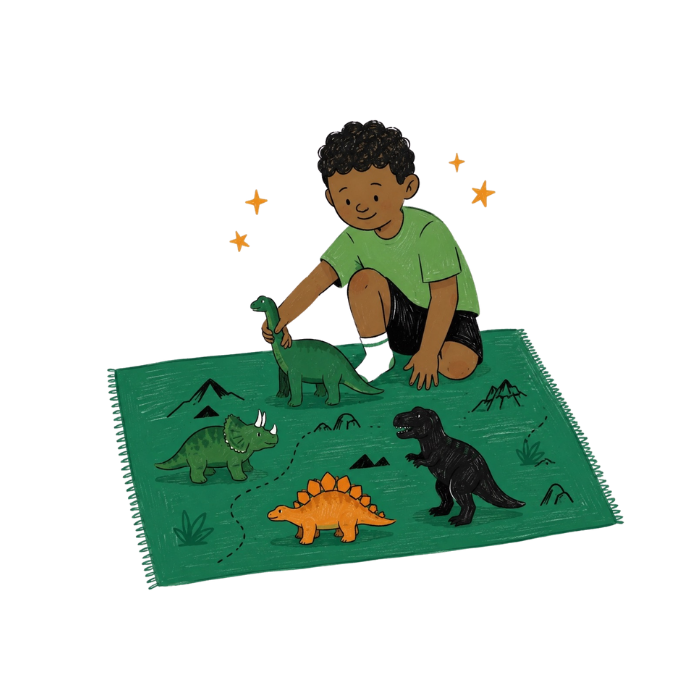
I don't say, "Today we're going to work on your anxiety," or "Let's talk about what happened at school."
Instead, I offer something simpler and more powerful: freedom within limits.
I introduce the room—and myself—warmly. I let your child know that in this space, they get to decide what they do and how they spend our time together. There are a few safety limits (we don't hurt each other, we don't break things on purpose), but within those, they lead.
For many children, at first this can be disorienting. They're so used to being told what to do, how to behave, what's right and wrong about how they're acting—that genuine, non-directive freedom feels almost suspicious.
Wait… I actually get to choose?
Yes. And what they choose tells me so much.
What I'm Watching (While They Play)
This is the part parents often don't realize: I am always working, even when it looks like nothing is happening.
While your child plays, I'm observing:
What themes come up — Does play repeatedly involve danger, being trapped, needing rescue? Conflict with authority? Chaos that no one controls?
How they regulate — Do they escalate as the session goes on, or settle? Do they seek connection with me, or stay distant?
What they avoid — Sometimes what a child won't touch is as telling as what they reach for first
Their body language — Are they tense? Relaxed? Do they make eye contact? Do they drift toward the door?
How they respond to limits — When I gently set a boundary, does it cause collapse, rage, shutdown, or a surprising sense of relief?
And as they play, I do something that might seem small but is actually one of the most therapeutic things I offer: I track and reflect.
I might say quietly, "You're putting them all in the same place. The house feels full." Or, "That one keeps getting left out." Or simply, "You decided."
I'm not interpreting. I'm witnessing. I'm showing your child: I see you. I'm not afraid of what I see. And I'm not going anywhere.
For many children—especially those who feel like their emotions are "too much" for the adults around them—this experience alone begins to change something.
So Is There Any Structure? Or Is It Just Free Play?
Child-centered play therapy is intentionally non-directive—meaning your child leads, and I follow.
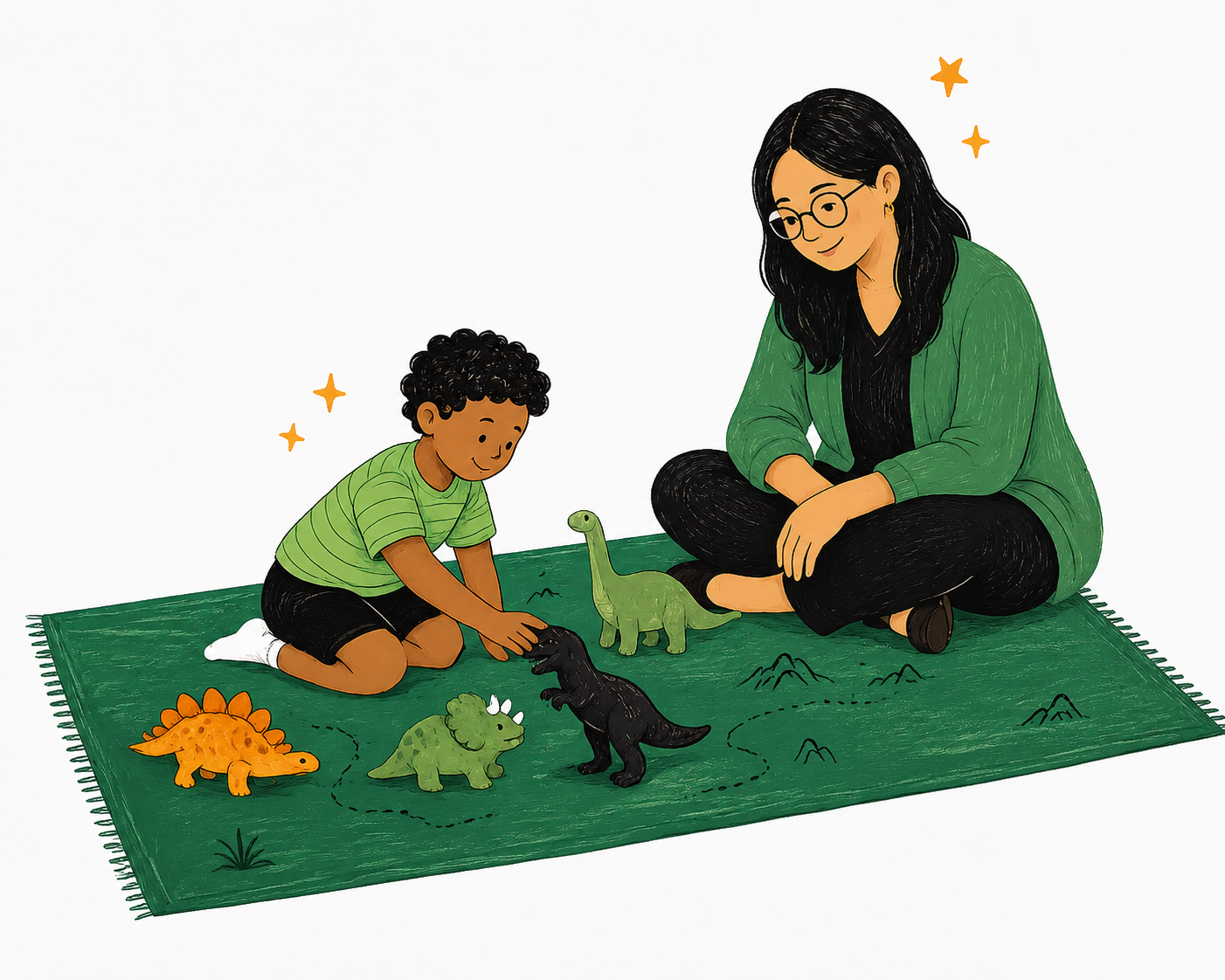
But that doesn't mean it's random.
The structure lives in:
The consistent, predictable space (same room, same toys, same time each week)
The reliable relationship (a therapist who shows up the same way, every time)
The gentle limits (which teach nervous system regulation more than any consequence ever could)
The therapeutic tracking (where I reflect and witness what your child is expressing)
For children who live in chaotic home environments, whose nervous systems have been shaped by unpredictability or early stress, that consistency IS the medicine.
Healing doesn't happen in dramatic moments. It happens in the accumulation of small, safe, repeated experiences.
What About Older Kids? Do They Still "Just Play"?
Great question. And the answer is: it depends on the child.
For children ages 3–9, play is almost entirely the primary language of the session.
For preteens and older kids, I often incorporate more conversation, art-based expression, or collaborative activities—but the underlying principles stay the same. We follow their lead. We don't force disclosure. We create safety before we ever ask anything of them.
Because whether a child is six or twelve, the question underneath the behavior is the same: Is it safe to be me here? Will I be accepted even if you see all of me?
Play therapy—in all its forms—answers yes.
What You'll Notice at Home
Here's something important I always prepare parents for: change often looks messy before it looks better.
After early sessions, some children:
Come home quieter than usual (processing)
Are more emotional for a day or two (the lid is coming off what was stuffed down)
Want more physical closeness with you (attachment activating)
Ask unusual questions (integrating new awareness)
This is not a sign that something is wrong. It's often a sign that something is moving.
Over time—typically 3–6 months of consistent sessions—you'll begin to notice:
Meltdowns that used to last 45 minutes starting to shorten
Your child finding words for feelings they previously could only express through behavior
More flexibility at transitions
Greater capacity for connection—with you, and with others
The work is slow, and it is real.
A Note for Parents of Faith
If you're coming to this as a Christian parent, you might be wondering: Where does God fit into a play therapy room?
I hold my faith as central to how I do this work—not as something I impose on children, but as something that shapes how I show up.
When I sit with a child in the play room, I believe I am witnessing the image of God in someone small and sacred. When I offer unconditional presence to a child who has known conditional love, I believe that is a form of grace.
The therapy room can be a place of healing that honors the whole child—mind, body, and spirit.
You don't have to check your faith at the door to pursue help for your child. And I won't ask you to.
You Don't Have to Figure This Out Alone
If you've been sitting with questions about whether play therapy is right for your child—wondering what it looks like, whether it would work, whether your child would even try it—I hope this helped.
The truth is, most children take to the play therapy room more naturally than their parents expect. Because we're not asking them to do anything foreign.
We're just giving them space to be what they already are: people who communicate through play.
If you're ready to learn more, I'd love to connect. A free consultation is a gentle first step—no pressure, just conversation.